Construction project management is hard. You have to control time, cost, quality, safety, and people for many projects at the same time. One delay, one mistake, or one wrong decision can affect the entire project and your profit.
In this guide, we will look at the biggest construction project management challenges and how modern, construction‑specific software like TDIT’s TDCM helps you solve them in a practical way.
Table of Contents
1. No clear, real‑time visibility across all projects
Many construction companies still run projects with Excel sheets, WhatsApp groups, phone calls, and separate tools for planning and reporting. This makes it very hard for management to see the true status of all sites in one place.
Typical problems:
- Leadership gets updates only in review meetings or when something goes wrong.
- DPRs (Daily Progress Reports) are inconsistent and sometimes not submitted.
- Data from sites is delayed and not trusted, so decisions are slow.
Business impact:
- Late action on delays and cost overruns.
- A lot of time spent collecting information instead of managing projects.
How TDIT’s TDCM helps:
- TDCM gives a central project dashboard where you can see progress, key metrics, and alerts for all active projects in real time.
- DPRs and site updates are captured in a structured way and automatically rolled up into clear reports for management.
- Multi‑project views show which jobs are on track and which need attention, helping owners and project directors act early.
2. Keeping complex projects on schedule
Construction projects have many dependencies: design, approvals, subcontractors, material delivery, and site conditions. When planning is weak or tracking is manual, schedules slip easily.
Common scheduling challenges:
- No proper baseline schedule with clear activities and milestones.
- Delays are recorded but their impact on overall completion is not understood.
- Site teams work with outdated plans or “mental schedules”.
Business impact:
- Frequent extension of time, liquidated damages, and frustrated clients.
- Overlapping work, rework, and poor coordination between trades.
How TDIT’s TDCM helps:
- Teams can build detailed project schedules with tasks, dependencies, milestones, and target dates in one system.
- Actual progress from DPRs is automatically compared with planned dates so you see slippage early.
- Integration with advanced tools like Oracle Primavera (where used) allows project managers to manage complex schedules with better control.
Make this section very practical by adding a short example of a high‑rise project and how a one‑week delay in concrete work affects all later activities, and how a system like TDCM shows this early.
3. Budget overruns and weak cost control
Keeping projects on budget is one of the biggest challenges in construction. Many firms lose money not because work is bad, but because they do not have tight control over BOQ, variations, and daily costs.
Typical cost control problems:
- Estimates and BOQs are prepared, but they are not digitally connected to execution and DPRs.
- Site teams track material and labour consumption in spreadsheets or notebooks.
- Variations and extra work are not logged properly, so billing does not reflect actual work done.
Business impact:
- Margin erosion and cash‑flow stress.
- Disputes with clients and subcontractors over quantities and claims.
How TDIT’s TDCM helps:
- BOQ, budgets, and cost items are managed in one system linked to project activities.
- Daily production and resource usage from DPRs feeds into cost dashboards, so you can see actual vs planned cost by activity and project.
- Alerts highlight unusual cost spikes or budget variance so managers can investigate quickly.
- Integration with ERP platforms like Oracle Fusion connects project data with billing and accounts, giving end‑to‑end financial control.
4. Communication gaps between office, site, and stakeholders
Construction projects have many stakeholders: owners, consultants, architects, project managers, site engineers, subcontractors, suppliers, and authorities. If communication is not structured, messages are lost and decisions are delayed.
Common communication issues:
- Important instructions sent through WhatsApp or phone calls, not recorded in any system.
- RFIs, approvals, and design clarifications scattered across emails.
- Site teams start work based on old drawings or assumptions.
Business impact:
- Rework and quality problems.
- Disputes about “who said what and when”.
- Slow approvals causing idle time and schedule delays.
How TDIT’s TDCM helps:
- TDCM provides structured workflows for site instructions, RFIs, approvals, and change requests, all recorded with time stamps and users.
- Messages, documents, and decisions are stored against the correct project and activity, creating a single source of truth.
- Role‑based access ensures each stakeholder sees only the information relevant to them, but everyone works on the same version.
5. Document and drawing management chaos
Contracts, BOQs, drawings, method statements, permits, inspections, and invoices all generate a huge amount of documents. When these documents are scattered across shared drives, pen drives, and email chains, mistakes become common.
Typical document challenges:
- People use old versions of drawings or method statements.
- No central register of key contracts, change orders, and approvals.
- Audits and claims become difficult because records are incomplete.
Business impact:
- Safety risks and quality issues.
- Time wasted searching for the right file.
- Weak position in disputes and claims due to poor documentation.
How TDIT’s TDCM helps:
- TDCM offers a centralized document management module with version control and access control.
- Drawings and documents are linked to specific projects, locations, and activities so site teams always know which file is current.
- Audit trails show who uploaded, changed, or approved each document, supporting claims and compliance.
6. Managing labour, subcontractors, and equipment effectively
Construction projects depend heavily on people and equipment. Tracking who is working where, how many hours they spent, and which machines are being used is difficult without a system.
Typical resource problems:
- Labour attendance and productivity tracked manually or not at all.
- Subcontractor work certification delayed or not linked to actual quantities.
- Equipment idle time and breakdowns not monitored.
Business impact:
- Higher labour and equipment costs than planned.
- Disputes over bills and work done.
- Lower productivity and poor utilisation of resources.
How TDIT’s ecosystem helps:
- TDCM connects with HRMS, fleet management, and other resource modules offered by TDIT to track labour, subcontractors, and assets in real time.
- Project managers can see resource allocation per project and adjust quickly based on progress and priorities.
- Data on resource usage flows into cost dashboards, giving a clear picture of productivity and unit costs.
7. Risk, safety, and compliance management
Construction work is inherently risky. Safety incidents, poor housekeeping, and weak compliance can stop projects and hurt your brand. Many companies still handle safety and risk manually, with paper forms and occasional checks.
Typical issues:
- Safety inspections and toolbox talks not recorded consistently.
- Waste disposal and site cleanliness not tracked, leading to penalties or shutdowns.
- No central view of risk register or mitigation actions.
Business impact:
- Accidents and near misses with serious human and legal costs.
- Regulatory penalties and project delays.
- Difficulty proving compliance to clients and authorities.
How TDIT’s TDCM and CDM help:
- TDCM can record safety inspections, checklists, and incidents at site level, giving management a live safety view.
- TDIT’s CDM (Construction Disposal Management) helps handle waste collection, disposal tracking, and site cleanliness in a structured way.
- Reports consolidate safety and compliance data across projects, supporting continuous improvement and audits.
8. Data silos and disconnected software tools
Over time, many construction firms adopt multiple separate tools for planning, accounting, HR, site reporting, and documents. These tools usually do not talk to each other.
Typical tech stack issues:
- Multiple logins and separate data entry for the same information.
- Reports created manually by merging data from different tools.
- Inconsistent numbers between project reports and finance systems.
Business impact:
- Extra overhead for project and accounts teams.
- Slow decisions due to fragmented information.
- Lower trust in data and analytics.
How TDIT’s digital transformation approach helps:
- TDIT does not just deploy one app; it designs an integrated architecture using project management (TDCM), ERP (Oracle Fusion, etc.), HRMS, analytics, and middleware.
- Data flows across systems, so you have one version of truth for projects, cost, and resources.
- Dashboards and reports combine information from multiple modules, simplifying management decisions.
9. Change resistance and poor adoption of new systems
Even the best software fails if people do not use it. Many construction teams are comfortable with manual methods and see new tools as extra work.
Typical adoption challenges:
- Site teams feel digital systems are “for head office only”.
- Training is limited, and support ends after go‑live.
- Systems are not designed for real site conditions, so staff go back to old habits.
Business impact:
- IT investments do not deliver expected value.
- Data remains incomplete, weakening visibility and analytics.global.
How TDIT manages adoption:
- TDIT runs discovery workshops to understand your projects, processes, and pain points before configuring TDCM.
- Implementation is phased, starting with pilots and high‑impact modules, then expanding across projects and functions.
- Training, support, and change‑management guidance are provided so site teams find the system simple and useful in their daily work.
How construction‑specific software solve these challenges together
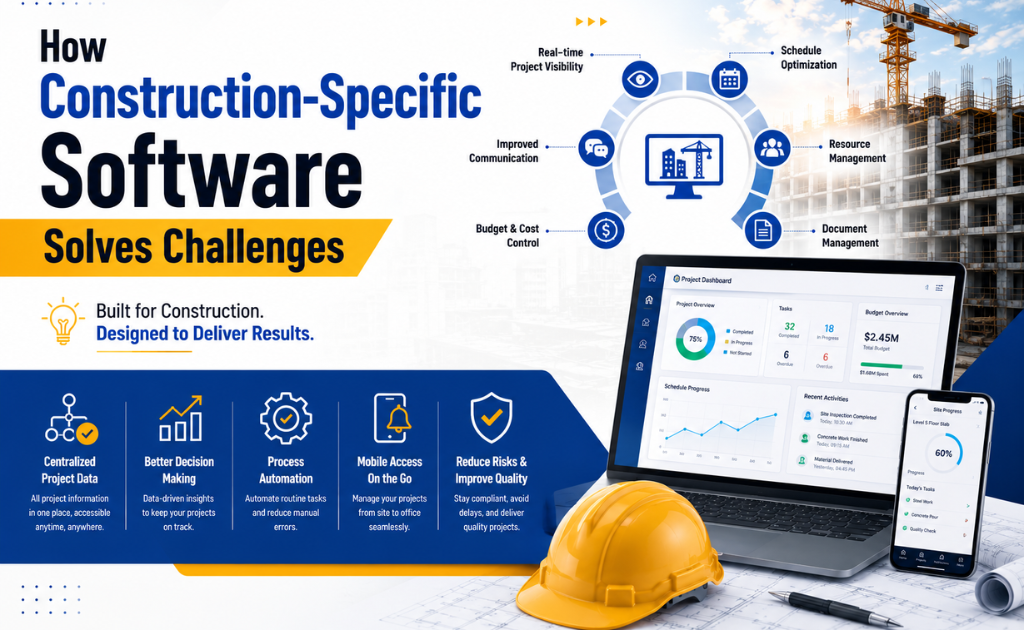
All of these challenges are connected. Poor visibility affects schedule and cost. Weak communication affects quality and safety. Disconnected tools create data silos.global. Oracle Partner
Generic project management tools can help with tasks and timelines, but they do not understand BOQ, DPR, multi‑site reporting, or construction‑specific workflows. This is why many construction companies are moving to industry‑specific platforms combined with ERP.
TDIT’s value proposition:
- TDCM provides construction project management built around real site processes: planning, scheduling, DPR, BOQ, cost control, site monitoring, and dashboards.
- Surrounding solutions like HRMS, fleet management, safety, CDM, and ERP integrations turn it into a full digital operations stack.
- TDIT’s team implements, customizes, and supports these solutions for contractors, developers, EPC companies, and infrastructure projects in India, GCC, and globally.
Conclusion: Turning challenges into a competitive advantage with TDIT
Construction project management challenges will not disappear. Projects are getting bigger, timelines are tighter, and clients expect more transparency. The companies that win are those that build strong digital systems and workflows that give them control over every project, site, and resource.
If you recognise these challenges in your own projects, it may be time to move from spreadsheets and scattered tools to a central, construction‑specific project management platform. TDIT’s TDCM and ERP solutions are built to help you gain real‑time visibility, control cost and schedule, improve communication, and make every project more predictable and profitable.