Why the Questions You Ask Will Decide Your ERP Success
For a mid‑sized Indian contractor and builders, choosing construction ERP is not a “software purchase”- it’s a decision that will affect how you estimate, plan, bill, and control every project for the next 5-10 years. The wrong choice means cost overruns, failed implementations, and project teams going back to Excel and WhatsApp while you keep paying ERP bills.
This guide gives you a practical list of questions to ask every vendor, organized by theme: construction fit, core capabilities, implementation, technology, cost, and support. You’ll also see what a “good answer” looks like for an Indian contractor, so you can separate real construction ERP vendors from generic “one‑size‑fits‑all” systems.
Table of Contents
Step 1: Be Clear About Your Own Business Before Talking to Vendors
Before you evaluate any ERP, you need clarity on how your company actually works today.
For a mid‑sized contractor in India, that usually means:
- Handling 5-20 active projects at a time.
- Working across multiple cities or states.
- Using RA bills, advances, retention, and variation claims with clients and subcontractors.
- Managing central stores plus multiple project stores and yards.
- Running accounting in tools like Tally and relying heavily on Excel and WhatsApp for day‑to‑day control.
Quick Self-Checklist (Fill This Before Vendor Demos)
Note these points so you can ask targeted questions later:
- Type of work: buildings, industrial, infra, interiors, MEP, mixed.
- Average project size and duration.
- Number of concurrent projects and sites.
Current pain points:
- Cost overrun visibility.
- RA bill delays.
- Variation tracking.
- Material wastage/pilferage.
- Subcontractor disputes.
- Cash‑flow and margin visibility.
Once you know this, you can use the questions below to see whether a vendor truly understands and supports your reality as a mid‑sized Indian contractor.
Questions About Construction Fit (Does This ERP Really Suit Builders and Contractors?)
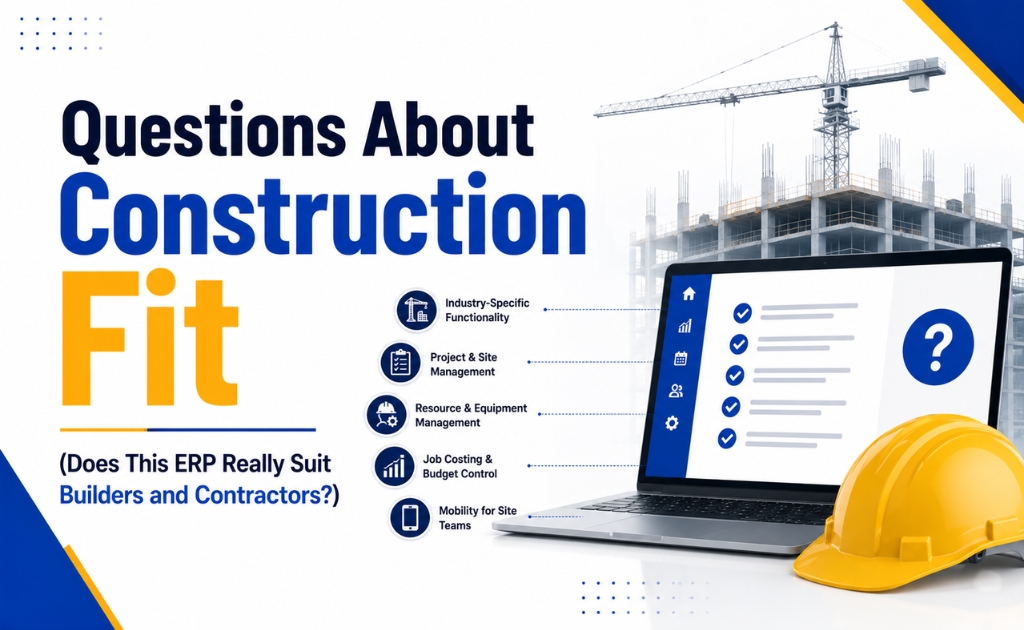
This is your first filter. If the product is not genuinely built for construction, nothing else will save the implementation.
Question 1: “Is Your ERP Built Specifically for Construction? Show Me, Don’t Just Tell Me.”
What to ask in the demo:
- “Show me how you create a project with BOQ/WBS.”
- “Show me how you set budgets and cost codes for each activity.”
- “Show me how the system handles multiple sites under the same project.”
What a good answer looks like:
- The product has project, BOQ/WBS, and site as core entities, not just extra fields.
- The interface uses construction language (BOQ, RA bill, WBS, site store) rather than generic manufacturing/trading terminology.
- They can run through a simple construction scenario end‑to‑end without confusion.
Red flag: they show a generic ERP demo—finance, HR, inventory—and struggle when you ask for a construction‑specific flow.
Question 2: “Do You Work With Companies Like Us-Mid-Sized Indian Contractors? Can You Share Examples?”
Why it matters: You want a vendor who understands Indian contracting practices, not just global theory.
Ask for:
- Number of Indian construction clients around your size.
- Example case studies (even anonymized) of 50–200 crore contractors.
- Whether they’ve handled RA billing, GST, TDS, retention, and subcontractor management in India.
Good answer: specific stories and references from Indian contractors, not vague “we can handle any industry”.
Question 3: “Can You Walk Me Through a Typical Project Lifecycle in Your System?”
Ask the vendor to show:
1. Tender/estimate and BOQ.
2. Project creation and budget approval.
3. Material planning and procurement.
4. Site execution and daily progress.
5. RA billing and variations.
6. Subcontractor billing and payments.
7. Project close‑out and final margin review.
Good answer: they can navigate this entire flow smoothly in the demo, using real‑looking data, without jumping into Excel for “missing” steps.
Questions About Core Functional Capabilities
Once you’re confident about construction fit, dig into the must‑have functions for Indian contractors.
Question 4: “How Do You Handle Job Costing, BOQ, and Cost‑to‑Complete?”
Ask them to demonstrate:
- Creating a BOQ/WBS‑based budget for a project.
- Capturing actual costs against BOQ items (materials, labour, subcontractors, equipment).
- Viewing planned vs actual and cost‑to‑complete for a project.
Good answer:
- Pre‑built job costing dashboards and reports specifically for projects.
- Easy drill‑down from project → BOQ item → individual transactions.
If they say, “You can build these reports later in BI,” that usually means the core ERP is not project‑centric.
Question 5: “How Do You Manage RA Bills, Advances, Retention, and Variations?”
In India, this is where money is made or lost.
Ask them to show:
- Preparing an RA bill with cumulative quantities and values.
- Applying client‑specific retention and advance recovery rules.
- Entering variation orders and linking them to the main contract and job costing.
Good answer:
- RA and retention are standard features, not customizations.
- The system clearly shows billed to date, retention held, and receivables per project.
Red flag: they only show simple, one‑time invoices and talk about RA as a “custom” requirement.
Question 6: “What Does Site‑Level Inventory and Procurement Look Like in Your ERP?”
Material control is a huge pain point for Indian contractors.
Ask them to demonstrate:
- How a site raises a material request to stores/procurement.
- How central stores manage stock and issue materials to multiple projects.
- How site‑to‑site transfers are recorded and tracked.
Good answer:
- Clear distinction between central store and site store.
- Visibility of stock by project and location.
- Reports for consumption, wastage, and pilferage trends.
If their inventory is built for a single warehouse and simple stock movements, they are not ready for multi‑site contracting.
Question 7: “How Do Site Teams Capture Daily Progress, Labour, and Issues?”
Ask specifically for mobile/site usage because your site engineers and supervisors will not log into a complex ERP screen.
Ask them to show:
- Daily progress entry for work fronts or activities.
- Labour attendance and productivity logging.
- Material receipts at site and issues to work.
- Attaching photos, drawings, and snag/safety observations.
Good answer: a simple, mobile‑friendly UI (app or responsive web) that site teams can actually use without IT help.
Questions About Implementation and Change Management
Mid‑sized contractors often fail not because the software is bad, but because implementation is generic and there is no change‑management.
Question 8: “Who Will Implement the ERP for Us, and What Construction Experience Do They Have?”
Ask:
- Is implementation done by your own team or partners?
- How many construction implementations have these consultants handled?
- Will we have a dedicated project manager from your side?
Good answer:
- Named implementation team with construction rollouts in India.
- Not just “we have done ERP in manufacturing and retail”.
Question 9: “What Is a Realistic Implementation Timeline for a Company of Our Size?”
For a mid‑sized Indian contractor, you want a phased rollout, not a forever project.
Ask them to:
- Break down the timeline into phases: discovery, configuration, pilot, rollout.
- Share typical duration for clients of similar size and complexity.
Good answer:
- honest ranges (e.g., 3–6 months for core modules and key projects), with reasons.
- Be wary of vendors promising “full implementation in a few weeks” for complex, multi‑site operations—that often leads to shallow setups and poor adoption.
Question 10: “How Do You Handle Training and Ensuring People Actually Use the System?”
Ask:
- What training formats do you offer (on‑site, online, role‑based)?
- How do you train site teams, not just head office?
- Do you provide manuals, videos, or in‑app guides?
- What support do we get in the first 3–6 months after go‑live?
Good answer:
- Structured training plan for different user roles.
- Extra hand‑holding and faster response SLAs during the initial adoption period.
Questions About Technology, Integrations, and Deployment
Indian contractors typically have Tally or another accounting system, HR/payroll tools, and sometimes BIM or project planning tools. Your ERP must fit that landscape.
Question 11: “What Deployment Options Do You Offer-Cloud, On‑Premise, Hybrid?”
Ask:
- Which options are available?
- What’s recommended for a mid‑sized Indian contractor and why?
- Good answer:
- Clear comparison of cloud vs on‑premise in terms of cost, security, and maintenance.
- Real examples of similar Indian clients running in your preferred model.
Question 12: “How Well Do You Integrate With Tally/Existing Accounting and Other Systems?”
Many Indian contractors want ERP to handle projects, while finance continues in Tally (at least initially).
Ask:
- Do you have ready integrations with Tally or other Indian accounting tools?
- How is data synchronized (one‑way, two‑way, frequency)?
- Can we integrate HR/payroll or project planning tools we already use?
- Good answer:
- Documented APIs and proven Tally integrations.
- Clear explanation of what flows where (e.g., project and cost data in ERP, financial postings pushed to Tally).
Question 13: “How Often Do You Update the Product and How Are Updates Rolled Out?”
Ask:
Update frequency (monthly, quarterly, etc.).
Whether updates are automatic or scheduled.
How you will be informed about changes.
Good answer: predictable, documented release cycles and minimal disruption, especially for cloud deployments.
Questions About Cost, Commercials, and Long‑Term Value
Mid‑sized contractors cannot afford hidden costs or pricing that explodes as they grow.
Question 14: “What Is the Full Cost Breakdown for a Company Like Ours?”
Ask vendors to break costs into:
License/subscription fees (by user, module, or project).
Implementation and configuration.
Customizations and integrations.
Training.
Annual support/maintenance.
Good answer: transparent brackets with assumptions (e.g., 30–50 users, core modules, 10-15 projects), and examples of similar Indian clients.
Question 15: “How Will Costs Change as We Add Projects, Users, or Modules?”
Ask:
How user pricing scales.
Whether there are project‑based or revenue‑linked fees.
What happens if you expand to new regions or business lines.
Good answer: a clear, predictable model that doesn’t punish you when you actually start using the system more.
Question 16: “What Are the Exit Terms-Data Ownership and Exports?”
Even if you never plan to switch, you should know your rights.
Ask:
Who owns the data?
In what formats can you export it if you leave?
How long will the vendor retain data after contract end?
Good answer:
You clearly own the data.
Vendor provides standard export options and reasonable timelines.
Questions About Support, Roadmap, and Vendor Stability
You’re not just buying features; you’re choosing a long‑term partner.
Question 17: “What Does Support Look Like After Go‑Live?”
Ask:
- Support channels (phone, email, ticketing, WhatsApp).
- SLAs for response and resolution times.
- Whether you get a dedicated account manager.
Good answer:
- Clear SLAs and an escalation path.
- References you can call to verify real‑world support quality.
Question 18: “How Many Construction Customers Do You Have, Especially in India?”
Ask for:
- Number of live construction clients.
- Count of Indian contractors and builders using the product.
- Good answer: a healthy base of construction customers with multiple references in India.
Question 19: “What Is Your Product Roadmap for the Next 2-3 Years?”
Ask:
- What new features and modules are planned.
- How customer feedback influences the roadmap.
- Good answer: a realistic roadmap that clearly focuses on construction (better job costing, mobility, analytics, integrations), not generic buzzwords.
How to Use These Questions in Your Vendor Selection
To make this practical:
- Create a simple grid: rows = questions, columns = vendors.
- For each question, note:
- Score (1–5).
- Notes on demo proof (did they show it live or just talk?).
- Shortlist 2–3 vendors who score highest on construction fit, core capabilities, and implementation track record-not just on price.
- Run a focused pilot or PoC on 1–2 real projects with your own data before full rollout.
This approach reduces risk and lets you see how each ERP behaves in your actual environment.
Why Many Mid‑Sized Builders and Contractors Shortlist TDIT
When you apply these questions in the Indian context, the vendors that stand out are those who:
- Are built around construction projects, BOQ, RA billing, and multi‑site inventory-not generic trading or manufacturing flows.
- Have strong Indian implementation experience and understand local practices like GST, TDS, retention, advances, and subcontractor billing.
- Offer a phased, realistic rollout plan with hands‑on support for site teams, not just head office.
TDIT Solutions fits that profile: it provides construction‑focused ERP and inventory solutions designed for contractors and builders, with project‑centric workflows, RA billing, subcontractor and site inventory control, and implementation expertise rooted in the Indian market. For mid‑sized Indian contractors who want to move off spreadsheets and generic tools into a single construction‑first platform, TDIT is often a natural name on the shortlist-and a strong candidate to test against the very questions you’ve just read.
Trusted Partner Of Oracle